إذا كانت هذه هي زيارتك الأولى، كن متأكدا من
تحقق من المساعدة ، بالضغط
الوصلة أعلاه. قد تضطر إلى التسجيل
قبل أن تتمكن من المشاركة: اضغط على الرابط السابق للتسجيل والمضي قدما. لبدء مشاهدة الرسائل،
قم باختيار المنتدى الذي تريد زيارته من الاختيار أدناه.
On the evening of the 27th day of the month, Muslims celebrate the Laylat-al-Qadr (the Night of Power). It is believed that on this night Muhammad first received the revelation of the Holy Quran. And according to the Quran,
. The month of Ramadan Kareem is very dear to Allah. It is the most august of all months, pure, generous and merciful. Do not let its nights go waste in slumber, its days in careless omission or loss of remembrance of Allah
I think Ramadan is a beautiful month, and a very very important month in our islamic religion. We should ask forgiveness from Allaah at all times but we should ask the most in Ramadan. Ramadan makes me have a really special feeling inside. It helps me realize how islam has guided me in the right path . I am so happy coze im muslima Alhamdolelah Ramadan Karem
Allahs Apostle used to practise Itikaf in the last ten days of the month of Ramadan
The Prophet used to (put) bend his head (out) to me while he was in Itikaf in the mosque during my monthly periods and I would comb and oil his hair
The Prophet used to perform Itikaf every year in the month of Ramadan for ten days, and when it was the year of his death, he stayed in Itikaf for twenty days
The Prophet used to practice Itikaf in the last ten days of Ramadan till he died and then his wives used to practice Itikaf after him
Umar asked the Prophet I vowed in the Pre-lslamic period of ignorance to stay in Itikaf for one night in Al- Masjid al-Haram.Prophet said to him,Fulfill your vow
Prophet used to practice Itikaf in the last ten nights of Ramadan and used to say, Look for the Night of Qadr in the last ten nights of the month of Ramadan
حدّ السحاااااب و فوق روس الجباااالي و أنا جلالة الملكة %
THE OBLIGATION OF FASTING
Allah says in the Quran:
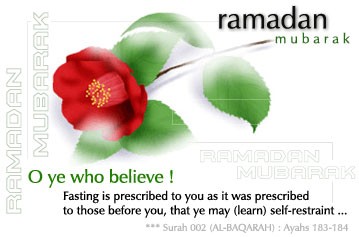
"O uou who have faith! Fasting is prescribed for you as it was prescribed for those before you - so that hopefully you will have taqwa." - Al Baqarah(2):183
Meaning that hopefuly you can safeguard yourselves from the Fire through Fasting; fasting is a means to the forgiveness of sins, and sins lead one to the fire.
The two sahihs record the hadith in which the prophet (pbuh) said:
"Islam is built upon five: that you worship Allah and reject the worship of anything else, to establish the prayer, the giving of Zakat, performing pilgrimage to the house and Fasting the month of Ramadan." [This is the wording of Muslim, Bukhari has the first sentence as 'that you testify none has the right to be worshipped save Allah'].
THE VIRTUES OF FASTING
Fasting carries with it a number of benefits, amongst which are: the elevation to ones rank, the expiation of sins, the breaking of ones desire and lusts, the increase of charity, the multiplication of actions of obedience to Allah, giving thanks to the one who knows the hidden matters, and preventing oneself from even contemplating the commiting of sin.
THE ELEVATION OF RANK
With regards to the elevation of rank, the Messenger of Allah (pbuh) said:
"When Ramadan comes, the gates of Paardise are opened, the gates of Hellfire are locked and devils are chained." [Bukhari]
He (pbuh) also said, relating from his lord Mighty and Magnificient,
"All of the actions of the son of Adam are for him except the fast for that is for me and I will reward it. Fasting is protecting sheild, so when it is the day when one of you are fasting, let him not behave or speak indecently; if someone tries to abuse him or fight him, let him say, 'I am fasting'. By the one in whose hand is the soul of Muhammad, the smell emanating from the mouth of the one fasting is better with Allah then the smell of musk. The one fasting has tewo time of joy, when he breaks his fast he is happy and when he meets his lord he will rejoice at his fasting." [Bukhari and Muslim]
The prophet (pbuh) also said:
"Every action that the son of Adam does, [its reward] will be multiplied, a good deed will be increased tenfold. Allah Mighty and Magnificient says, 'except for the fast, for that is for Me and I will reward it for he left his desires and food for My sake'" [Muslim]
The prophet (pbuh) also said:
"In paradise there is a gate which is called ar-Rayyan through which the people who fasted will enter on the day of Judgement, and no one else shall enter along-side them. It will be asked, 'where are those who fasted?' and they will walk through it, and upon the entry of the last of them, it will be locked, and no one else will walk through it." [Bukhari and Muslim]
With regards the 'opening of the gates of paradise', this is a phrase that points to the increase of actions of obedience that in turn lead to the opening of the gates of Paradise. 'Locking the gates of Fire' is a phrase that points to the decrease, and lack of therewith, of sins which in turn leads to the locking of the gates of the Fire. 'The chaining of the devils' is a phrase that points to the termination of their whisperings, and temptations, to those who are fasting because they give up hope of receiving a favorable response.
transferred
حدّ السحاااااب و فوق روس الجباااالي و أنا جلالة الملكة %
by al-Haafith Ibn Rajab al-Hanbal
Source: Based on Ibn Rajab's "Lata`if al-Ma`arif" and other sources
The first part of this is based on an extract from Ibn Rajab al-Hanbali's Lata'if al-Ma'arif (pp. 179-182), quoted by Fahd bin Sulaiman in Kayf Nastafeed min Ramadan (pp. 48-50). The advice given in this article is all the more important now that we are in the last ten nights of Ramadan. Imam Bukhari reports from 'Aishah that the Messenger of Allah (may Allah bless him and grant him peace) would tighten his waist-cloth (i.e. detach himself from his wives), spend the night in worship and awake his family, during the last ten nights of Ramadan. Ramadan is nearly over, so make the most of this precious opportunity!
Ramadan has a special relationship with the Qur'an, of course:
"The month of Ramadan is the one in which the Quran was sent down, a guidance for mankind, clear proofs for the guidance, the Criterion; so whoever amongst you witnesses this month, let him fast it." (cf. Surah al-Baqarah 2:185)
The word 'so' (fa) in this ayah leads to the following paraphrase of one aspect of its meaning: "Fast this month because it is the one in which the Qur'an was sent down" -- see Fasting in Ramadaan by Ali al-Halabi & Saleem al-Hilali, Al-Hidaayah, 1414/1994, pp. 11-12.
Ibn 'Abbas narrates "that the Messenger of Allah (may Allah bless him and grant him peace) was the most generous person, and he would be at his most generous in Ramadan because Jibril would come to him every night and he would rehearse the Qur'an with him." (Sahih al-Bukhari, Eng. trans. 6/486)
This hadith contains recommendation of the following:
• Studying the Qur'an in Ramadan;
• coming together for this purpose;
• checking (one's memory/knowledge of) the Qur'an with someone who has preserved it better;
• increasing recitation of the Qur'an in Ramadan;
• that the night time is the best time to recite, when other preoccupations decrease and it is easier to concentrate, as in Surah al-Muzzammil 73:6.
Further, Fatimah (may Allah be pleased with her) narrated from her father (may Allah bless him and grant him peace), who told her that Jibril would rehearse the Quran with him (in Ramadan) once every year, and he did so twice in the year of his death. (Bukhari 6/485)
After mentioning the above aspects of the Sunnah, Ibn Rajab talks about the situation of the Salaf (the early Muslims) during Ramadan:
"... Some of the Salaf would complete reciting the whole Quran during the night prayer of Ramadan every 3 days, others every 7 days e.g. Qataadah, others in 10 days e.g. Abu Rajaa' al-Atardi. The Salaf would recite Quran in Ramadan in Prayer as well as outside it. Al-Aswad would finish the Quran every 2 nights in Ramadan; Ibrahim an-Nakh'I would do likewise in the last 10 nights specifically, & every 3 nights during the rest of the month. Qataadah would regularly finish the Quran in 7 days, but in 3 days during Ramadan, when he would study the Quran especially, and every night during its last 10 days. Al-Zuhri would say when Ramadan began, 'It is recitation of the Quran and feeding of people.' When Ramadan began, Imam Malik would cease narrating Hadith and sitting with the people of knowledge, and stick to reciting the Quran from its pages, while Sufyan al-Thawri would leave other acts of worship and stick to reciting the Quran. 'Aishah would recite from the pages of the Quran at the beginning of the day in Ramadan (i.e. after Dawn), until when the sun had risen, she would sleep. Zayd al-Yaami would bring copies of the Quran when Ramadan began and gather his companions around him. ..."
Ibn Rajab later continues, "The forbiddance of completing recitation of the Quran in less than 3 days applies to this being made a regular practice, but as for favoured times such as Ramadan, esp. the nights in which Laylat al-Qadr is sought, or favoured places such as Makkah for the visitor, it is recommended to increase reciting the Quran to avail the time and place. This is the view of Ahmad, Ishaq & other Imams, and the practice of others indicates this too."
The purpose here is not to discuss whether or not the latter view is correct or not, since that is purely academic for most of us, as we do not get anywhere near reciting the whole Quran in three days! However, the practice of the Prophet (may Allah bless him and grant him peace), his Companions, and those who followed their path, should be clear enough. As a further example, Bukhari (3/79) quotes from the noble Companion Zaid bin Thabit who answered the question, "How much time was there between the pre-dawn meal and the Dawn Prayer?" by saying, "Enough time to recite fifty ayat"; since the practice of the Arabs was to measure time in terms of everyday actions, this shows that the Sahabah were pre-occupied with the Qur'an, especially in Ramadan.
Compare all this with our sad state, when we talk so much about establishing Islam, implementing the Quran, etc. and yet have such little contact with it, maybe not completing its recitation ever at all since childhood, or perhaps never! Hence we become imbalanced in our understanding of Islam, because there are ayat which we rarely or never hear or think about; we repeat only certain selected ayat over and over again; we lost the con**** of the verses, the overall flow, argument and balance of the Quran, all of which is beautiful & miraculous. Because of this ignorance we go astray from the Straight Path, split up into sects, lose the blessings of Allah ...
"We took a covenant from those who said: we are Christians, but they forgot part of the message with which they had been reminded, so we ingrained amongst them enmity and hatred until the Day of Judgment..." (Surah al-Ma'idah 5:14)
In Sahih Bukhari (6/521), there is an amazing piece of advice from the Prophet (may Allah bless him and grant him peace): "Recite the Quran as long as your hearts agree on it; if you disagree about it, stop reciting it (for the time being)" -- studying the Quran should bring people together!
In Surah al-Mu'minoon (23:53), there is mention of the people before us (in whose footsteps we would follow), who broke up their Deen into sects (zuburan), each party rejoicing in what it had. One understanding of this, from the word zuburan meaning literally 'books', is that each sect left the Book of Allah, & concentrated solely on the books of its own sect, so "they split their deen up into books"!
The most twisted, ridiculous, shallow ideas, innovations and superstitions are propagated amongst Muslims when they are away from the Quran, because any little knowledge of the Quran would be enough to dispel them.
Hence, O slave of Allah, leave aside secondary books and concentrate on studying the Blessed Book of Allah in this Blessed Month (use a good translation/commentary if needed), for it is the source of all Knowledge in other books, and keep away from wasting time, especially in futile discussions and arguments which lead nowhere, for that is a sure sign of being misguided, as the Prophet (may Allah bless him and grant him peace) said, "Whenever a people went astray after they had been on guidance, they were given to argumentation (jadl)." (Ahmad, Tirmidhi, Ibn Majah - Sahih al-Jami' al-Saghir, no. 5633)
Finally, remember that the Messenger (may Allah bless him and grant him peace) will complain to Allah on the Day of Judgment that his people neglected the Qur'an (Surah al-Furqan 25:30). Neglect of the Qur'an is of different levels, as Ibn al-Qayyim writes:
• not reciting or listening to it;
• not studying and understanding it;
• not conveying its message;
• not judging by it in personal and communal matters, at all levels of society;
• not believing in it.
All Praise is due to Allah, Lord of the Worlds.
Abu Dharr, Ramadan 1415.
I take this opportunity and remind all Muslim sisters and brothers that Lailatul Qadr can be any time as of tonight
Seize the opportunity and read and recite a lot of Qur'an and do your Tahajud prayers by reading from the Glorious book
transferred
حدّ السحاااااب و فوق روس الجباااالي و أنا جلالة الملكة %
Ramadan is the ninth month of the Islamic lunar calendar. Every day during this month, Muslims around the world spend the daylight hours in a complete fast. A. During the blessed month of Ramadan, Muslims all over the world abstain from food, drink, and other physical needs during the daylight hours. As a time to purify the soul, refocus attention on God, and practice self-sacrifice, Ramadan is much more than just not eating and drinking.
Muslims are called upon to use this month to re-evaluate their lives in light of Islamic guidance. We are to make peace with those who have wronged us, strengthen ties with family and friends, do away with bad habits -- essentially to clean up our lives, our thoughts, and our feelings. The Arabic word for "fasting" (sawm)literally means "to refrain" - and it means not only refraining from food and drink, but from evil actions, thoughts, and words.
During Ramadan, every part of the body must be restrained.
The tongue must be restrained from backbiting and gossip. The eyes must restrain themselves from looking at unlawful things. The hand must not touch or take anything that does not belong to it. The ears must refrain from listening to idle talk or obscene words. The feet must refrain from going to sinful places. In such a way, every part of the body observes the fast.
Therefore, fasting is not merely physical, but is rather the total commitment of the person's body and soul to the spirit of the fast. Ramadan is a time to practice self-restraint; a time to cleanse the body and soul from impurities and re-focus one's self on the worship of God
transferred
إله السماء إلهٌ واحد
وآلهة الشيعة إثنى عشر دعاء السنة لله صاعد
ودعاء الشيعة رهينُ البشر
During this Ramadhan do not let the sweetness of our deeds vansh into the night, leaving only emptiness. When one contemplates the texts on fasting, its wisdom and goals in Shariah, and looks at the reality of the Muslim communities, one realizes a wide gap between the reality and our obligations. Remember that Ramadhan is a bounty that Allah blessed His servants with, to strengthen their faith, and increase their piety (Taqwa). Allah said: "O you who believe! Fasting is prescribed for you as it was prescribed for those before you, that you may become pious." (Al-Baqarah 2:183). This article is an attempt to present the essential causes of this gap, and to some remedies. primary reason for the gap is ignorance about the goals of fasting and the wisdom behind it. Many Muslims ignore the purpose and wisdom of fasting. Fasting is done merely to conform to the social environmet without contemplation. If one is not aware of the divine wisdom of Shariah and its fruits in this world and in the hereafter, one will not apply it in the right way. Goals of Fasting Achieving Taqwa: is one of the most important wisdom of fasting. Fasting brings on Taqwa as it lessens the desire of the stomach and mutes the ***ual appetite. Whoever fasts frequently would overcome these two desires more easily. This deter against committing abominations and sins and assist in controlling life leading to Taqwa. Strengthening willpower and acquiring patience: The Prophet sallallahu alayhe wa sallam called Ramadhan the month of patience as it increases one's will power to control his desire and the selfishness of his soul. This training allows him to be strong in following Allah's commands. The most important being to carry the Message and propel it forward. The person trains himself to be patient in obeying Allah by stopping at the limits set by Allah both by way of action and abstention. Allah said: "These are the limits set by Allah, so approach them not." (Al-Baqarah 2:187) Fasting is pure worship: The fact that he is abstaining from food and drink both in public and in secret shows his honest faith and strong love of Allah, and his knowledge and feeling that Allah is all-knowing of everything. For this reason Allah has made the reward for fasting greater than for any other type of worship. Allah said in the hadith Qudsi: "Every deed of the son of Adam will be multiplied [in rewards], the good deed by ten of its like, up to seven hundreds, up to whatever Allah wills, except fasting, it is for Me and I will reward it. He abandons his desire and his food for My sake.." (Related by Muslim) lbn al-Qayyim said: "...And people may see that a person is not eating in front of them, but the fact that he is really abandoning his food and his desire for the sake of God is a thing that nobody can find out about, and that is the essence of fasting." (Zaad al-Ma'ad 2/29). Relieving Muslims from life's distractions: Eating, drinking, and socializing all distract a person and weaken ties with Allah. It is by the Mercy of Allah that Muslims are ordered to fast so as not to be bothered by the intrusion of these activities. Nor by the thought about them nor the anticipation for them when devoting themselves to the all types of worship Either reading the Qur'an, offering additional prayer or making I'tikaf. For this reason the Prophet sallallahu alayhe wa sallam said: "Fasting is a shield, and a secure fortress against Hell fire" (Related by Ahmad). Discovering Allah's Blessings: A person experiences the hardship of the poor. He should then be thankful to Allah Who has blessed him with His bounty while others are deprived. This should make him more sympathetic and willing to share this bounty. The poor rediscovers that fasting helps a person be more devoted to worship. More able to concentrate and meditate. He should then be able of this devotion all year long, a blessing he should thank Allah for. Acquiring strength and endurance:It has been discovered that depriving the body of food for a period of time helps its defense and endurance mechanism. This in turn this protects the body from certain diseases. Remember that fasting is not only dependent on abstentions: Many believe that fasting consist only of certain abstentions, forgetting that Allah established certain acts of worship with fasting. Among which are: Qiyamul-layl: The Prophet sallallahu alayhe wa sallam said: "Whoever performed the night prayer during Ramadhan out of belief and anticipating God's rewards, will be forgiven his previous sins."(Related by Muslim).Performing Umrah: The Prophet sallallahu alayhe wa sallam said: "An Umrah during Ramadhan is like a Hajj with me." (Related by al-Hakim). Offering Iftar (meal) to those who fasted. The Prophet sallallahu alayhe wa sallam said: "Whoever feeds a fasting person has the same reward as him, except that the reward of the fasting person will not be diminished." (Related by Ahmad). Reading and completing the Qur'an: The Prophet sallallahu alayhe wa sallam said: "Fasting and [reading] Qur'an will intercede for the person: fasting will say: O Lord I forbade him eating and drinking so let me intercede for him, and the Qur'an will say: I deprived him from his night sleep so let me intercede for him," he then said: "So they will intercede." (Related by Ahmad). The Prophet sallallahu alayhe wa sallam used to recite the whole Qur'an to Angel Jibreel each Ramadhan. Giving in charity: Ibn Abbas radhiallahu anhu said: "The Prophet sallallahu alayhe wa sallam was the most generous among people, and he was more generous during the month of Ramadhan." (Related by Muslim). I`tikaaf: which is to confine oneself in the masjid for prayer and invocation leaving the worldly activities. Ibn Abbas radhiallahu anhu said: "The Prophet sallallahu alayhe wa sallam used to perforrn I'tikaf during the last ten days of Ramadhan." (Related by Muslim). It is surprising that many people have abandoned I'tikaf though the Prophet sallallahu alayhe wa sallam never abandoned it from the time he arrived to Madinah until he died. Supplication: In the verses dealing with fasting, Allah said: "And when My slaves ask you (O Muhammad) concerning Me, then answer them, I am indeed near to them. I respond to the invocations of the supplicant when he calls on Me." (Al-Baqarah 2: 186). This is an encouragement for the fasting person to increase his invocation. The Prophet sallallahu alayhe wa sallam said: "Three invocations will be answered: The invocation of the fasting person, the invocation of the oppressed, and the invocation of the traveler." (Related by Muslim). Repentance: Ramadhan is the time of repentance and return to Allah, for it is a time when the devils are chained, and when many people are saved from hell fire every night by the grace of Allah. Applying oneself in all good deeds in the last ten days of Ramadhan: Aysha radhiallabu anha said: "When the last ten days come, he sallallahu alayhe wa sallam would pray most of the night and wake his family, and apply himself, and tighten up his loincloth.", and she also said: "The Messenger of Allah sallallahu alayhe wa sallam used to strive in the last days of Ramadhan more than he did during the other days." (Related by Muslim). Abstaining from vain talk: Sins decrease the reward of fasting although they do not annul it. The Prophet sallallahu alayhe wa sallam said: "Fasting is not [only] abstaining from eating and drinking, but abstaining from vain and obscene talk, so if someone insulted you or wronged you say: I am fasting." (Related by al-Hakim) and he also said: 'Whoever does not abandon lying, then Allah does not need him to abandon his food and drink." (Related by al-Bukhari). Common errors made during Ramadhan Excessive spending: Ramadhan should be a time to avoid being wasteful, and learning to be prepared in facing harder times by distinguishing the needs from the luxuries. Unfortunately, many people go beyond their limits to spend during Ramadhan. Whether in the varieties of food that they savor each night, or by the other types of spending.
Staying awake during the night and sleeping during the day: Some people sleep during most of the day when they are fasting. Ramadhan is not a time of being lazy, and this do not allow the full benefit from the experience of fasting. It is as if they have only inverted their nights into days and vice versa. In addition, some may spend a great portion of the night indulging in eating and drinking and socializing Spending more time in socializing: Because people invite each other more often during Ramadhan they do tend to spend more time socializing with friends, and relatives. While it is a good deed to feed the fasting person, this should not result in precious time lost in vain talk. Use the occasion for remembering Allah and offering additional prayers, and for the Da'wah to Allah. Insisting on performing a certain number of Rakaas during the Tarawih (night) prayer to the point of not praying behind the Imam and thus forfeiting the benefit of congregational prayer. This might also bring hatred and disagreement between the Muslims of one community. Reading Qur'an too fast: Some insist on finishing the whole Qur'an once or more, even if they have to read very fast. Although reading the Qur'an many times is desirable, this should not be done hastily, especially during the Tarawih prayer without pondering upon its meaning. Allah ta'ala said: "This is a Book which We have sent down to you, full of blessings that they may ponder over its verses," (Saad 38:29), and the Prophet sallallahu alayhe wa sallam said: "Those who read the Qur'an in less than three days do not grasp [its meaning]" Socializing in l'tikaf: Many people are eager to do I'tikaf but some confine themselves in the masjid not to pray and worship Allah but to talk and socialize. The ways of doing good are numerous in Ramadhan Many people try to perform more than they are able to. By going beyond their capabilities, they end up not performing any deed in the desired way. Scholars and Dai'ahs should assume a more prominent role in educating the people - both by talking to them and by giving the best example in their behavior which should comply to the Shariah and following the Sunnah. The Muslim should realize that his priorities dictate that he does what benefits him in the Hereafter and should not put worldly interests first.
The Muslim should apply himself to deepen his sense of following the Sunnah of the Prophet sallallahu alayhe wa sallam, in every aspect of his life, at all times and especially during the month of Ramadhan. This necessitates seeking more knowledge about the Fiqh of fasting and its etiquette, assimilating the wisdom and goals of fasting, and facilitating the means that allow all the Muslims to benefit from their fasting
transferred Al-Jumuah Magazine, Vol 8, Issue
حدّ السحاااااب و فوق روس الجباااالي و أنا جلالة الملكة %
This is a common but interesting question which a child may ask his/her parents. Non-Muslim may also pose it to Muslims. Here are some of the reasons why Muslims observe a one-month fasting during Ramadan.
(1) To obey Allah's injunction
Muslims must believe in, obey and implement, all the words of Allah contained in the Holy Qur'an.
This is because Allah’s words are the truth, injunctions and guidelines he (swt) made for all people. Allah (swt) says:
(The truth is from your Lord, so be not at all in doubt)[Qur’an 2:147]
The injunctions of Allah to Muslims are regarded as blessings and mercy, and when fully obeyed, they often lead to Allah’s straight path. There is no compromise with Allah's injunctions: every sincere and God-fearing Muslim must obey them; this is a necessary precondition for being a Muslim.
Fasting is an important injunction that is directed to all Muslims (men and women), Allah (swt) says:
(O you who believe, fasting is prescribed for you...)[Qur’an 2:183]
This injunction prescribed fasting as a compulsory duty for all Muslims, thus Allah (swt) says:
(O who believe, fasting is decreed for you as it was decreed for those before you; perchance you will guard yourselves… The month of Ramadan is the month in which the Qur’an was sent down, a guidance for the people, and clear verses of guidance and criterion.)[Quran 2:183]
Clearly, fasting Ramadan is a divine injunction mandatory for all able-bodied Muslims who are free from compelling excuses. Whoever deliberately forgoes fasting in Ramadan, should know that he has disobeyed Allah's injunction and no amount of fasting thereafter can give her/him a reward equivalent to one missed Ramadan as obvious in this hadith:
Abu Huraira reported that Prophet Muhammad (pbuh) said:
"whoever did not fast one day of Ramadan without a genuine excuse or a disease then even if he fasted for a complete year, it would not compensate for that (missed Ramadan) day"(Sahih al-Bukhari, vol 3,p.88)
(2) To practice the tradition, and way of the pious people.
Fasting is not new to Islam; it is, indeed, as old as Adam, who was the first creature and the first Muslim to submit to only one Allah.
Qur'an mentions that Prophet Moussa used to fast for 40 days and Prophet Muhammad (pbuh) said that Dawood used to fast for half of the year. Also, 'Issa (or Jesus) used to fast for 40 days.
Since these Prophets were Muslims, it can be seen that by asking Muslims to fast, Allah intends to draw their attention to the practice and tradition of those pious predecessors who attained piety through fasting.
(O ye who believe, fasting is prescribed for you as it was prescribed for people before you ...)"[Qur’an 2:183]
This verse shows that fasting was observed by the people (i.e "ahl el ketab") who existed before Muslims and so it is a "sunnat Allah" (i.e a tradition approved by Allah) for those who lived aforetime and for the Muslims who are now the best generation ever raised for mankind. Allah (swt) says:
("As for” the sunnat Allah (approved) for those who lived aforetime, no change will you find in “such” sunnat-Allah)[Qur’an 33:43]
Therefore, fasting Ramadan should be seen as a propagation of the tradition approved by Allah for all those who submit to him.
3) To learn how to attain piety
By the very nature of human beings, they are susceptible to sins and transgression of Allah's limits. Generally, Muslims are prohibited from gossiping, backbiting, slandering, hypocrisy, lying, cheating, grudges, fornicating as these vices oppose the teachings of the Holy Qur'an.
Since Muslims are human beings created to err as a result of forgetfulness, they need to be reminded and coached against any social vices from time to time. This will require a fixed training period where Muslims will know and learn how to put an end to vices, learn virtues and get closer to Allah. That training period is fasting during Ramadan, which occurs once in every year. During Ramadan:
(a) Compulsory five daily prayers are observed regularly and timely.
(B) Zakat-ul fitr (alms giving) is paid on or before the “Eid Al Fitr (the festival that commemorates the end of Ramadan), Zakat-ul fitr is to teach Muslims to do charity (sadaqa) and to remind them that after Zakat-ul fitr they should not forget to pay on time their annual divine obligatory Zakaat, the fourth pillar of Islam.
(d) Muslims must lower their gaze during Ramadan (to free Muslims' hearts and eyes from corruption and from devil’s whisperings to do evil deeds).
(e) Excessive intake of food is avoided (this regulates the stomach from being pot-bellied).
All these good things which fasting fast teaches Muslims are the means to attain piety. This is why the verse on fasting Ramadan says:
(O ye who believe, fasting is prescribed for you...so that you will (learn how to attain) piety)[Qur’an 2:183]
(4) To reap the full reward of the “Night of Power” (Lailat-al Qadr)
The Qur'an was revealed to Prophet Muhammad (pbuh) in one night during Ramadan. It is called the night of Power (Lailat-al Qadr). The deed in this night is better than the rewards of deeds of 1,000 months (about 83.3 years).
Specifically, this night is in the last ten days of Ramadan and usually in one of the odd days (i.e. 21, 23, 25, 27 and 29th). A Muslim is expected to perform extra prayers (Nafelah), recite the Qur'an, do “zikr” etc …in the night. Since no one knows precisely which of the odd days is“Lailat al-Qadr”, Muslims are expected to be in seclusion (Etikaf) during the last 10 days of Ramadan and the best place to do so is in the mosque.
It should be mentioned that Angels descend in succession during the Lailat al-Qadr and they go round with special greeting of "peace" till dawn. The number of these angels is uncountable and they descend with special command of Allah.
The following chapter of the Qur'an details the event of Lailat al-Qadr:
(Indeed we have revealed it (Qur'an) in the night of Power “lailat al-qadr”. And what will explain to you what the night of Power is? The night of Power is better than a thousand months. Therein descends the Angels and the Spirit by Allah's permission, on every errand: (they say) Peace (continuously) till the rise of Morning!)[Qur’an 97:1-5]
Thus, Any Muslim who wishes to benefit from the Night of Power must fast during the month of Ramadan.
(5) To show Muslims how to get their past sins forgiven
Islam is a religion that stresses equality: both the poor and the rich (men or women) are equal as slaves in the sight of Allah. In Islam the surest way to obtain Allah's forgiveness for one's past sins is Pilgrimage (the fifth pillar of Islam) which unfortunately is only easy for the rich to afford its expenses.
But Allah (swt) never ignores the poor; rather he made fasting during Ramadan as a means of placing the poor and the rich on equal footing in terms of asking for forgiveness for their past sins.
If a Muslim can not perform hajj, there should be a way to compensate him/her. Allah has chosen Ramadan for all Muslims to get their past sins forgiven as evident in this hadith:
Narrated Abu Huraira(r.a); Prophet Muhammad (pbuh) said:
"... whoever fasts during Ramadan with sincere faith and hoping for his reward from Allah will have his past sins forgiven"
(Sahih Al-Bukhari, vol.3 p.70)
Therefore, Fasting Ramadan unites Muslims and brings them together, as equal slaves to Allah, who can be forgiven of their past sins devoid of discrimination in the sight of Allah.
6) To show that fasting is the epitome of the five pillars of Islam
Islam is built upon five pillars. The third pillar is fasting (i.e fasting during Ramadan). The wisdom behind its third position is because it is a fulcrum upon which the other four pillars (Tawheed, salaat, zakat and Hajj) are balanced. It is the only pillar that encompasses all the four other pillars in the sense that:
(a) Before someone observes fast, he/she must be a Muslim, sane, matured, and free from excuses (such as menstruation, illness, traveling long-distances, child-birth bleeding, etc). And since a Muslim is required to proclaim “Shahada” (i.e Tawheed, the first pillar of Islam), fasting is directly tied to “shahada”.
(B) Praying is the second pillar of Islam that distinguishes Muslims from others; this means that a Muslim must pray regularly to become a true Muslim. It follows that fasting during Ramadan without regular praying is meaningless.
(d) Hajj (pilgrimage) is a duty which Muslims owe to Allah and it is to help the pilgrims to get their past sins forgiven. Coincidently, fasting during Ramadan has the same result.
From the foregoing, it can be concluded that fasting is an epitome of the pillars of Islam. Therefore, every able-bodied Muslim must fast to learn how the other four pillars operate.
transferred
حدّ السحاااااب و فوق روس الجباااالي و أنا جلالة الملكة %
The month of Ramadan is a gift from our Lord. Its days are the sweetest
...
27-08-2009, 02:38 AM
Loading...
No more items.
جاري العمل...
😀
😂
🥰
😘
🤢
😎
😞
😡
👍
👎
☕
نحن نعالج البيانات الشخصية لمستخدمي موقعنا عبر استخدام ملفات تعريف الارتباط (الكوكيز) وتقنيات أخرى، وذلك لتقديم خدماتنا، وتخصيص الإعلانات، وتحليل نشاط الموقع. وقد نشارك بعض المعلومات الخاصة بمستخدمينا مع شركائنا في الإعلانات والتحليلات. لمزيد من التفاصيل، يُرجى الرجوع إلى سياسة الخصوصية.
بالنقر على "أوافق" أدناه، فإنك توافق على سياسة الخصوصية وعلى ممارساتنا المتعلقة بمعالجة البيانات الشخصية وملفات تعريف الارتباط كما هو موضح فيها. كما تُقرّ بأن هذا المنتدى قد يكون مُستضافًا خارج بلدك، وتوافق على جمع بياناتك وتخزينها ومعالجتها في البلد الذي يُستضاف فيه هذا المنتدى.












تعليق